Arduino
Arduino is the world’s leading open-source electronics platform, encompassing both the core hardware and essential software needed for creating interactive projects, prototypes,and DIY applications. These microcontroller-based boards are fully programmable using the dedicated Arduino Integrated Development Environment (IDE), providing a flexible and user-friendly environment for innovation.
Additionally, to ensure you have the right components for projects across all levels of expertise, Arduino offers a comprehensive range of products, including various board types (like the classic Arduino UNO), modules and kits.
Types of Arduino Boards
The wide variety of Arduino boards available allows users to select the optimal platform based on project complexity, processing power, and connectivity needs. Some of the more common types include:
Entry Level
Entry-level Arduino boards are ideal for beginners and students, offering simplicity, a robust design and extensive online community support, making them perfect for foundational projects and learning.
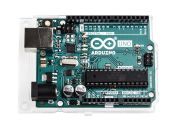
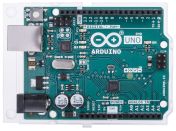
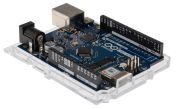
Arduino UNO R3
This is the foundational Arduino board, widely used for teaching and prototyping due to its robust design, ease of use, and comprehensive community support. The UNO R3 is a reliable starting point for learning the basics of electronics and coding.
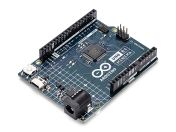
Arduino UNO R4 Minima
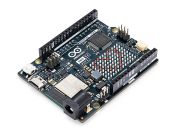
An evolution of the UNO R3, the Minima maintains the standard form factor while offering a more powerful Renesas RA4M1 32-bit microcontroller, higher processing speeds, and greater memory capacity for more demanding initial projects. It allows for effortless migration of existing UNO projects while providing enhanced performance.
Arduino Nano
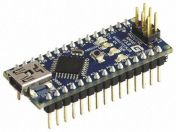
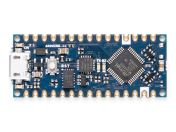
A small, complete, and breadboard-friendly Arduino board, the Nano is perfect for compact projects and permanent installations where minimising space is a key constraint. Despite its size, it provides the essential functionality needed for many small-scale applications.
Advanced Features
Boards in this category are designed for more complex projects that require higher computational power, faster clock speeds and expanded memory compared to entry-level models. They often leverage more powerful 32-bit microcontrollers, opening the door for demanding applications like robotics and signal processing.
Arduino Mega 2560
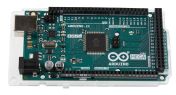
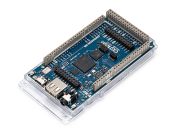
Equipped with 54 digital I/O pins, 16 analogue inputs, and four UARTs, the Arduino Mega 2560 is designed for large projects requiring multiple connections — such as 3D printers or complex robotics.
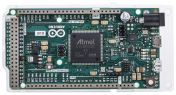
Arduino Due
The Arduino Due is a powerful board utilising a 32-bit ARM Cortex-M3 microcontroller, making it suitable for large-scale creative projects that require high computation and extended connectivity. It significantly increases the data handling capabilities and processing speed over the traditional UNO.
Arduino Zero
Designed for IoT innovation and advanced projects, the Arduino Zero provides a powerful 32-bit architecture with excellent performance and debugging capabilities. This board is perfect for embedding in complex, high-performance gadgets and devices.
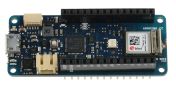
Arduino MKR Zero
This compact board is ideal for learning 32-bit application development, leveraging its size and power efficiency for small embedded projects. Its inclusion of an on-board SD connector makes it perfectly suited for robust data logging and adding storage capability to portable, battery-powered systems.
IOT Boards
These Arduino boards are specifically optimised for the Internet of Things (IoT), providing integrated wireless connectivity (Wi-Fi and/or Bluetooth) and enhanced security features right out of the box. They are essential for projects requiring network communication, remote data collection and cloud integration.
Arduino UNO WIFI Rev2
The Arduino UNO WiFi Rev2 is an excellent entry point into the Internet of Things (IoT), combining the reliable UNO form factor with integrated Wi-Fi connectivity. It also features a secure cryptographic element, simplifying the process of connecting to online services securely.
Arduino GIGA R1 WiFi
The Arduino GIGA R1 WiFi is a high-performance board featuring both Wi-Fi and Bluetooth connectivity for maximum versatility. It’s designed for complex projects like advanced robotics or high-fidelity audio processing that demand significant memory and computational power.
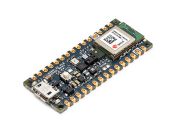
Arduino Nano 33 BLE
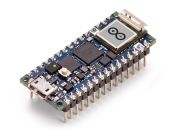
The Arduino Nano 33 BLE is a tiny, low-power Arduino board with integrated Bluetooth Low Energy (BLE), making it an optimal choice for miniature IoTs and wearable applications. Its compact size, coupled with integrated motion sensors, also makes it perfectly suited for embedded, battery-dependent projects.
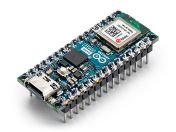
Arduino Nano ESP32
The Arduino Nano ESP32 is a compact yet powerful IoT board that harnesses the ESP32 chip, offering both Wi-Fi and Bluetooth connectivity. It supports Arduino and MicroPython, making it versatile for IoT developers.
Specialised Boards
Arduino also offers a range of specialised boards tailored for professional or advanced applications, such as:
Arduino Portenta H7
The Arduino Portenta H7 is a high-performance board designed for industrial IoT, AI applications, and machine vision. It supports both real-time and high-level operating systems on dual cores.
Arduino Nicla Series
Best known as ultra-compact boards designed for edge AI and sensor integration, the Arduino Nicla Series is suitable for applications such as predictive maintenance and motion detection in industrial systems.
Applications of Arduino
The versatility of the Arduino platform allows it to be leveraged across virtually every technical discipline, supporting a wide range of applications including:
Home Automation
Arduino boards and sensors can be used to control household systems, including customised lighting, climate control, and security monitoring. The platform allows users to design highly adaptable and cost-effective smart home solutions leveraging simple inputs and wireless communication.
Robotics
For robotics projects, the Arduino platform is utilised as the central control unit, effectively processing sensor inputs and precisely managing motor output. Its simplicity, combined with its robust nature, makes it the ideal choice for quickly prototyping robotic movements and testing new functionalities.
Wearable Technology
The small form factor and low power consumption of specialised Arduino boards, such as the Nano series, make them perfect for creating custom smart clothing or tracking devices. These platforms allow users to easily integrate various components and sensors to collect and transmit vital data, such as motion and biometric readings.
Educational Teaching
The Arduino platform is widely adopted in educational institutions globally to teach the fundamentals of programming, electronics, and engineering concepts. The visual and accessible nature of the Arduino board provides an engaging, hands-on learning experience, making complex technical subjects easy to grasp for students at all levels.
IoT
As many modern Arduino boards include integrated Wi-Fi or BLE modules, the platform is fundamental to creating devices that connect and communicate over the Internet. It is extensively used for critical functions like remote monitoring, complex data logging, and building sophisticated networked control systems.
Choosing the Right Arduino Board
When selecting your Arduino board, it’s important to consider the following:
- Project Requirements: Evaluate your processing needs, input/output pin count, memory, size, and connectivity options.
- Power Consumption: Projects powered by batteries benefit significantly from low-power boards, which maximise operational longevity.
- Connectivity: For Internet of Things (IoT) projects, you should choose boards that include necessary wireless modules (e.g., Wi-Fi, Bluetooth).
- Community and Support: Popular boards often come with the advantage of having extensive online tutorials and community assistance available.
- Expansion Compatibility: Always ensure the chosen board offers full compatibility with any required shields and expansion modules for future growth.
Your Trusted Arduino Hardware and Components Solutions Partner
Purchasing your Arduino hardware and components from our digital store is a streamlined and convenient process. Our extensive online range includes a wide variety of Arduino boards — and associated products such as push button switches and potentiometers — from leading brands such as Arduino and DFRobot. Once you’ve selected your preferred Arduino components, easily complete your order using our secure payment methods.
Our reliable delivery service also ensures the fast, nationwide doorstep delivery of your products across Singapore. For complete specifics on dispatch timelines, applicable charges and shipping choices, please refer to our dedicated Delivery Page today.
Popular Searches
Related links
- MikroElektronika Click for Arduino UNO Click Shield Arduino UNO and Compatible Boards
- Infineon BLDC Shield_TLE956X Linear Regulator for TLE9563-3QX Motor Control IC for Arduino Boards
- Arduino Uno Rev 4 WiFi
- Arduino Uno Rev 3
- Italtronic Transparent Arduino Case for use with Arduino Uno
- Arduino Uno Rev 3 SMD
- Arduino Uno Rev 4 Minima
- Safety Barriers